Thursday, October 11, 2012

Oct 11

Today has been a training day. This project seems to have “education” written on it from every angle: not only is EDEM all about access to education, but today I have been teaching. Now that we have progressed with the reviews, the time has come to actually implement the new financial procedures and so I spent the day with Herve and Mineve going through cashbook expense accounting (basic bookkeeping), quarterly reporting and cash flow/funding request processes.

Today has really taken me back to the absolute essentials of accounting. We are making financial records – it is as simple as that. There are no computers: we are using paper and pen. There is no prior experience of accounting here so going through the process meant that I was challenged to explain everything from “point zero”. The exercise gave me great insight into how many implicit professional references we ordinarily make; when those become worthless, I had to be explicit.
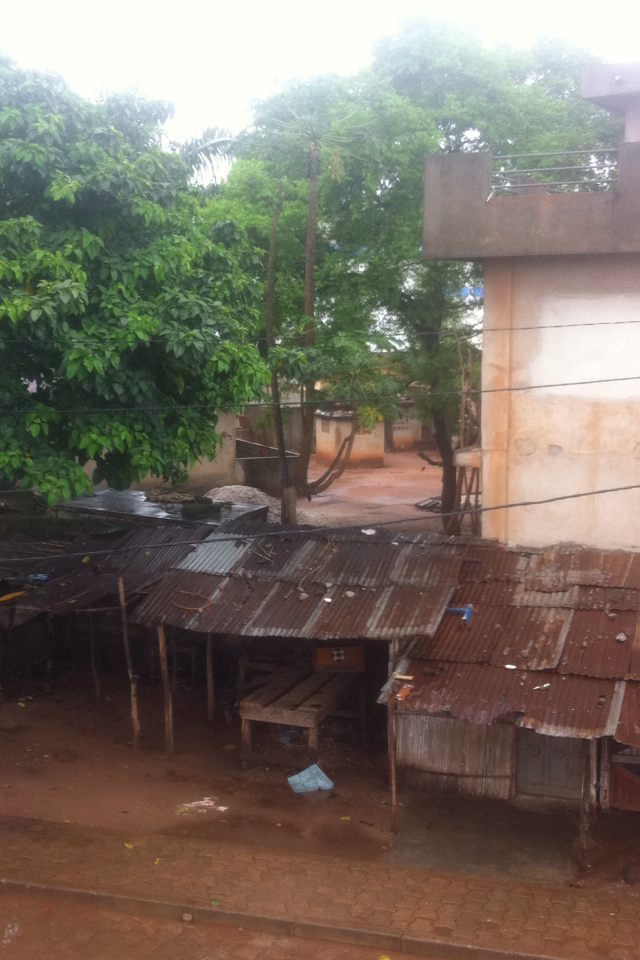
Herve’s motorbike is broken so today we did a lot of walking and I got to see Porto-Novo close-up. Today’s rains seem to have turned the “contrast” up even higher: the red earth roads seem to luminesce against the dark grey skies. In amongst the beauty there were lots of not-so-beautiful things: mounds of rubbish, stagnant ponds, derelict buildings, pot holes you could lose a child in… But the locals don’t seem to notice: around town today I saw cheerful people with lots of friendly smiles!
Photo: Herve and Mineve at the office…

Wednesday, October 10, 2012

Oct 10

Having visited a school it became clear that getting the children to school is only one part of the challenge as the schooling situation is very difficult! There is an average teacher to student ratio of 1:50; only 1 in 3 primary school teachers and 1 in 20 secondary teachers are on permanent state contracts; and 71% of teaching hours are delivered by unqualified teachers. Furthermore only 2 in 3 schools are considered to be in “acceptable” condition today; and in the future, to meet the growing demographic demand, 25,000 more schools will have to be built and staffed by 2030.

Now that EDEM is already significantly helping orphans and vulnerable children (OVCs) by getting them to the schools, they have further project plans to help children maximise the value of their school attendance. Herve tells me that he really wants to set up a breakfast distribution for children and we also reviewed the idea of creating a “homework” space to assist the children to learn after school. To compensate for the lack of books and computers at school, their offices could become a school lending library with computer access. Even just offering basic sanitation (on the way to/from school) might encourage some children to go to school rather than stay at home…
Meanwhile the finance review is progressing – the first chapter of the report is drafted! We know what needs to be done to make the systems more robust so that donors can have greater confidence in the future when EDEM both increases current activities and starts new projects: both of which will require more funding. This type of work and intended benefit is very much in line with Accounting for International Development’s mission. Read more in the The Guardian: www.guardian.co.uk/social-enterprise-network-partner-zone-santander/safeguarding-overseas-charities-from-recession
Photo: What EDEM recently presented to 198 OVCs at the start of the school year...

Tuesday, October 9, 2012

Oct 9


After having worked on the accounts today, Herve took me to visit some of the families of the children whom EDEM supports. There are two very positive points in Benin regarding orphans and schooling. First, the orphans are not without shelter – the surviving parent or aunts and uncles provide for the child. Second, Benin has the schools – it is simply a question of getting the children to the schools. The negative point regarding orphans and schooling is the relative poverty which is exacerbated by no longer having one or both parents earning an income. This poverty can mean that it is not just the school fees which are a barrier to going to school but the fact that if the child goes to school, there is one less person to earn an income for the family.
And the poverty really is pronounced. For me, the culture shocks continue but despite becoming slowly acclimatised, nothing prepared me for what I saw today. It’s such a different world that it’s quite difficult to believe that we share the same planet! In the centre of town people call home a lean-to shack with no electricity, water or sanitation. Cooking is done on wood fires and there are no modern conveniences. Whilst the setting is urban, it as if the way of life is still principally rural. In this environment, the people have considerable needs and hopes: not least the children, but almost half the children aged 5-14 work. Hopefully, education is a means to escape the poverty trap.
EDEM acts as a sort of “guardian” for the children to not only help them get to school but to then encourage them and follow their progress. This also means visiting the families and offering support and advice to the parents. This is what I saw today, zooming round town and through the market on the back of Herve’s motor bike. I was glad I was not driving because for a visitor the rules of the road seem impossible to decipher! Later, watching the national news headlines, the culture shocks continued: a chimpanzee that was causing havoc in town was shot by police (much to the delight of a watching crowd); at the market a thief was lynched; and there were “only a few” road accidents today!
Photo: the EDEM office and transport
 

Monday, October 8, 2012

Oct 8

Benin is a developing country and “Espoir de Demain” (EDEM) is a very apt name for this local NGO: hope for tomorrow is what it is all about. Benin needs to train a whole battalion of engineers, doctors and professionals to take this country to the next level. For all the proposed infrastructure improvement projects of today, locally there isn’t yet the talent available to deliver. Meanwhile, primary schooling is free and secondary school fees have just been reduced. The demographics mean that the young outnumber the old so the challenge is to make sure that as many children as possible get to benefit from this education so they can help their country grow.

EDEM is doing just that by supporting orphans and vulnerable children who are those most at risk from not being able to benefit from the education. Whilst 65% of boys and 58% of girls attend the (free) primary school, for a country with 47% of the population living below the poverty line (1.25$/day), it is not surprising that attendance rates drop to 34% of boys and 23% of girls for the (fee paying) secondary schools. Those fees are relatively little compared to developed countries. To get a child through secondary school (fees, uniform, equipment and books) would cost less than two euros per week per child!
I met with Herve from EDEM today to get an overview of the charitable “offer”, how it’s positioned, what other NGOs are doing and not only what is done today but what can be done tomorrow. We have plenty of ideas for the future but whilst the ideas are free, implementing them is not and EDEM would need to achieve more funding. In order to achieve more funding EDEM needs to have robust financial and operational systems in place that can give confidence to the donors that their donations are being used correctly. That’s where I might be able to help.
Towards the end of the day I got to see Porto Novo. I saw Nigerian immigrants attending a service in English in their makeshift church and Catholic nuns herding their charges into theirs. The Moslem call for prayer drew my attention to the mosque which, like most of the other buildings is principally a concrete block except for the roofing. There are not many paved roads – dirt tracks prevail – but with people selling wares from shelters and shacks that line the streets, with wandering merchants balancing their stock on their head and with the aroma of bar-be-ques here and there, the whole town seems like one big street market!
Photo: downtown Porto Novo.
 

Oct 7

Sunday the 7th was a very long day: whilst the flight was only 6 hours to travel the 3000 miles to get here, it took another two and a half hours to collect the baggage. That would be a long time to collect your bags at the best of times, but with 380 other passengers in a baggage collection space designed for about a hundred, with 32 degrees and 95% humidity, it was an experience!

Still, I was reunited with my bag and the experience did not influence my first impressions. Through the eyes of a Westerner visiting this country for the first time, the place appears louder, brighter and more colourful than home! It’s like someone has taken a European television and pressed the plus button on every scale to make an African version!

More animated, more life, more living in the moment. That seems to be the essential: the loudness and bright colourfulness are perhaps just the consequences of this dynamic. Time certainly appears to be fluid here, as illustrated by my very kind hosts who took me to a great street-side restaurant on the way to my hotel. We had wonderful chicken-and-rice and time just melted.
Arriving late at the hotel it had been quite a journey! It was so late when I arrived that Porto-Novo was actually quiet; but not so from the early hours of this morning! The traffic is very much part of the loudness and this hotel is located on an intersection so it was a good job I had anyhow planned to get up reasonably early!

Photo: view from by hotel window...


Saturday, October 6, 2012

Oct 6

The day before: the time to answer why: what is this all about?

It started with "Accounting for International Development", an organisation who provides non-profits and social enterprises with a specialist volunteer programme designed to build the financial management capacity of small community organisations (www.afid.co.uk).

I'm the volunteer and this seemed to be a perfect fit for me: as a financial professional and chartered accountant I wanted to be able to offer my specialist skills to help others on a voluntary basis.

AfiD matched me with Youth Action for Change International (www.yaci.co.uk) who support children and vulnerable adults in poor countries through local charities. They needed a finance volunteer to help them help a charity called Espoir de Demain (EDEM) based in Porto-Novo, Benin.

EDEM aims to support orphans and vulnerable children (OVCs) in Benin through schooling, apprenticeship, social support and awareness raising. They have already managed to school 158 OVCs in Porto-Novo, but there is always greater need.

In order to expand they need to strengthen their financial management. That's where I can help, and that's why I'm going. In a brief couple of weeks the plan is to perform a financial and strategic audit, review the financial controls and accounting systems, and advance with funding applications.

The journey starts tomorrow!